Market Themes and Observations Shaping 2026
We wanted to share some thoughts and observations from 2026 and provide some brief context around some of the risks facing investors as we move forward.
Year-to-Date Market Returns
Through August, it’s been another good year for stocks, both in the U.S. and overseas. Most broad market indexes are up 10% or more. Small cap stocks and emerging markets have been particularly strong, as have energy and technology sectors.
Bonds have struggled as interest rates around the world have been on the rise, while commodities have performed well, driven mainly by rising energy prices.

Index Performance Disclosure: Index returns are shown for illustrative and informational purposes only and do not represent the performance of any Divvi Wealth Management client account or investment strategy. Indexes are unmanaged and cannot be invested in directly. Index returns do not reflect advisory fees, transaction costs, taxes, or other expenses that may reduce an investor’s actual return. Past performance is not indicative of future results.
Scary September?

Historically, September has been the worst month for the S&P 500. The average price return is -1.08%. We are not aware of many compelling economic reasons the market should decline because the calendar changes, but the data is what it is.
On the flip side, September weakness has often set the stage for markets to move higher. The four months that follow (Oct through Jan) have typically been quite good.
We believe investors should consider factors like economic growth, corporate earnings, valuations and interest rates rather than rely on seasonal calendar patterns.
Source: Yardeni Quicktakes, Beware: September is Back Again, September 1, 2026
AI – impact on investments and jobs and growth
The pace of innovation is remarkable. Artificial intelligence (AI) is arguably the most influential driver of our economy and markets.
Employment
Fears of AI taking human jobs are common and perhaps justified. However, research from the New York Federal Reserve suggests some of these fears may be overblown, at least for now. Only 4% of service firms and no manufacturers reported AI-related layoffs over the last 6 months. They may be hiring fewer human workers than in a world where AI didn’t exist, but the more common response has been to retrain – not lay off – existing workers.

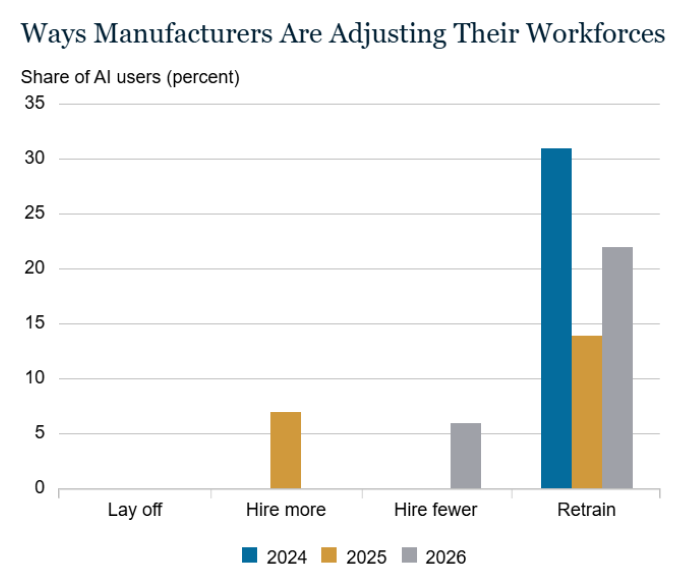
Source: Liberty Stree Economics, The Federal Reserve Bank of New York, September 1, 2026
Markets and Investments
A lot has been written about AI’s potential impact on investment returns. Some of the more common topics in 2026 have circled around data center construction, the unprecedented demand for compute, impact on traditional software companies, and power.
One way to think about the AI buildout is in the context of builders and beneficiaries. Builders might include the hyperscalers providing cloud services, model companies creating the AI models, and chip companies enabling faster compute. Beneficiaries may be the users of AI tools to drive higher profit margins and greater productivity.

Vanguard shared the chart, Earnings optimism is driving value index returns. Value-oriented indexes had underperformed growth counterparts since the early 2010s, in large part due to having less exposure to the technology sector. But value is showing a resurgence in 2026 and earnings expectations (the brown shaded bars) have improved. Vanguard also notes that many value indexes have recently benefitted from some technology companies becoming valued attractively enough (a low price to earnings ratio, for example) to be included in those indexes.
Investors will have a challenging time avoiding AI exposure going forward. Broad equity exposure may already have meaningful exposure to AI-related companies, which could create concentration risk.
Source: Vanguard Market Perspectives, as of August 19, 2026
Growth
Vanguard recently published a piece forecasting 3% U.S. GDP growth in 2027, and included the line, “Such growth will not represent incremental improvements, but rather a fundamental shift in the economy’s growth trajectory.” They concluded, “…we foresee an economic sea change.”
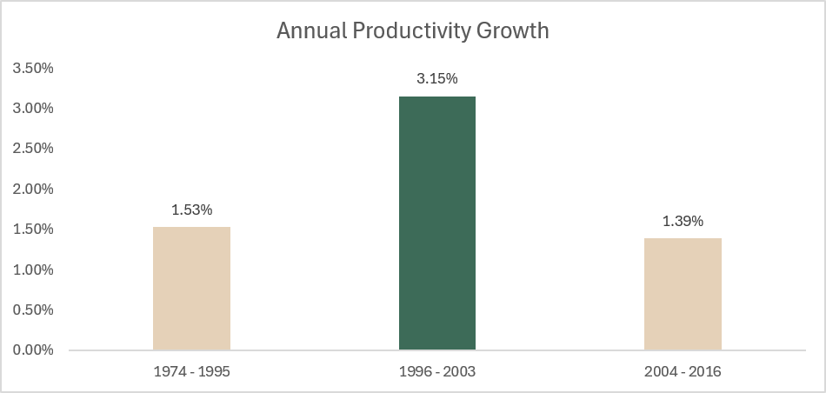
We expect similar sentiments will be shared by other firms and organizations later this year. However, faster long-term growth is not guaranteed, and forecasts and projections like this are inherently uncertain and should not be viewed as guarantees of future economic or market results. The tech boom in the late 1990s may be a particularly useful historical comparison.
U.S. productivity rose from about 1.5% annually in 1974 to 1995, then jumped to 3.15% from 1996 to 2003, before falling back to 1.39% from 2004 to 2016.
Source: Federal Reserve Board
Rates and inflation

One of the biggest stories of 2026 has been interest rates, specifically rising rates.
The Federal Reserve is scheduled to meet again in mid-September and markets are expecting rates to move higher, suggesting a 92% chance of 25 basis point hike vs. an 8% chance of no change. (As of 9/14/2026)
To us, the changes on the longer end of the yield curve have been just as interesting. 10-year Treasury rates are essentially back where they were in early 2025, at nearly 4.8%, and up from 4.0% earlier this spring.
Source: St. Louis Federal Reserve (FRED), Divvi Wealth Management
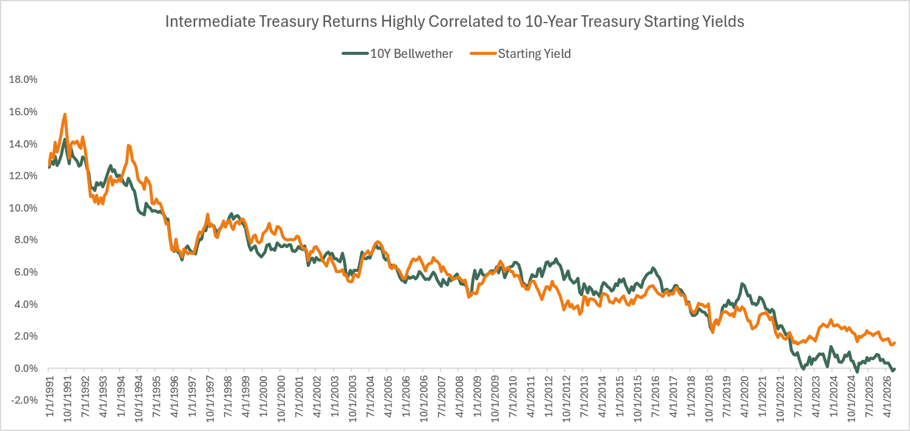
Historically, future bond returns have been highly correlated with the starting yield. The chart below shows the 10-year annualized total returns of the Bloomberg 10-year U.S. Treasury Index (green) and the yield for the 10-year U.S. Treasury bond (orange) at the beginning of that period.
That suggests today’s starting point may be better – 10-year yields are around 4.75% -- than it was during most of the 2010s and early 2020s, when rates were near historic lows. It’s also worth noting that interest rates were falling during most of the period presented in the chart, providing a tailwind for bond prices. If rates continue to move higher from here, bond investors could be disappointed.
Source: Morningstar Direct, Divvi Wealth Management

Capital Group, one of the largest asset managers in the world, looked at stock returns during periods of rising rates, too. They pointed out that the S&P 500 has historically performed well. One explanation is rates are rising due to faster economic growth expectations, which would often lead to higher corporate profits.
Higher rates can be a more significant headwind for stocks with the highest growth expectations, and smaller companies who generally rely more of debt financing than free cash flow for funding.
Source: What higher interest rates could mean for stocks and bonds | Capital Group, September 3, 2026
Earnings
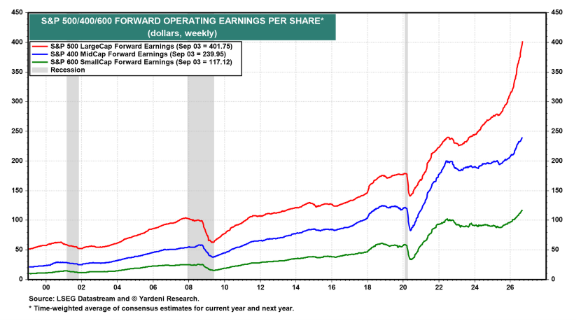
Stock prices are being driven higher by earnings growth, not higher price multiples – a stark difference from what transpired during the last tech boom in the late 1990s. Earnings per share rose over 50% during the 2nd quarter of 2026, and about 25% if we don’t include paper gains from mark-to-market investments.
Wall Street strategist Ed Yardeni points out this isn’t just a large cap story, either. Earnings expectations for mid-sized and small capitalization stocks are also rising to record levels.
We think this should be viewed as a positive by investors. If prices were being pushed higher because investors were willing to pay more for a dollar of earnings or revenue, we would view that as a more concerning backdrop.
Source: Yardeni Quicktakes: More Fabulous Earnings Momentum, September 6, 2026
Politics and Geopolitics

The war with Iran has reduced the amount of oil flowing through the Strait of Hormuz. Oil prices have been volatile since Spring, and inflation expectations are reflecting higher energy prices.
Markets seem to believe this conflict will be relatively short-lived and companies will be able to handle higher energy costs. After an initial drawdown of about 9% in February and March, the S&P 500 has rallied to return over 20% from those lows. But sentiment can change quickly, and we think investors should expect market volatility until a resolution is reached.
Americans are also preparing for mid-term elections. Elections seem to have a way of making markets jittery. Maybe it’s the never-ending sea of ads, many of which try to use fear to motivate potential voters.
How have markets reacted to mid-term elections? The chart from Capital Group below shows that, since 1950, the S&P 500’s average one-year price returns following midterms have been over 15%. I would hesitate to say mid-terms are the reason for strong returns. Instead, I think other factors like corporate profits and economic growth tend to be more important than who controls Congress for the next two years.
Source: How U.S. midterm elections may affect markets | Capital Group, May 13, 2026
Summary: What could go wrong?
AI could cause unemployment to rise. Investors may be overestimating AI’s impact on economic growth and future corporate profitability. The conflict in Iran could restrict global oil supply for longer than expected, pushing inflation and interest rates higher. Investors are always faced with uncertainty. Today is no different.
As always, if you’d like to talk through your portfolio or your broader plan, please reach out to the Divvi team.
Disclosure
This material is provided by Divvi Wealth Management (“DWM”) for general informational and educational purposes only and is intended for a broad audience. It is not individualized investment, tax, legal, accounting, or estate planning advice and should not be construed as a recommendation to buy or sell any security or to adopt any particular investment strategy.
DWM is an investment adviser registered with the U.S. Securities and Exchange Commission. Registration with the SEC does not imply a certain level of skill or training.
Investing involves risk, including the possible loss of principal. Past performance and historical market trends are not indicative of future results. Market indexes are unmanaged, cannot be invested in directly, and do not reflect advisory fees, transaction costs, taxes, or other expenses that may affect an investor’s actual results.
Charts, graphs, data, and other information presented are intended solely to illustrate market or economic concepts and should not be relied upon, by themselves, to determine the suitability of any investment or strategy. Information obtained from third-party sources is believed to be reliable, but DWM does not guarantee its accuracy or completeness.
Forward-Looking Statements: This material may contain forward-looking statements, forecasts, estimates, or expectations regarding economic conditions, financial markets, interest rates, corporate earnings, or other future events. Such statements reflect views as of the date of publication, are subject to change without notice, and involve assumptions and uncertainties. Actual outcomes may differ materially, and no assurance can be given that any forecast or expectation will be realized.
DWM does not provide legal, tax, or accounting advice. Please consult the appropriate professional regarding your individual circumstances.
For additional information about DWM’s services, fees, conflicts of interest, and other important disclosures, please review DWM’s Form ADV Part 2A and Form CRS.